
When it comes to existing pathways for becoming a computer science teacher, the U.S. government tracks new and initial teacher certification in the Title II report. But many computer science (CS) teachers may have started as a teacher of math, business, or another subject and only later earned a CS certification. The result is a gap in our understanding of the pathways that teachers follow to become CS teachers. A better understanding of these pathways is important to our understanding of the CS education landscape. It is currently difficult if not impossible to determine at a national scale, for example, what kinds of teacher preparation lead to more impactful CS teachers, or what pathways are more or less likely to result in lackluster teacher retention.

Our Plan and Goal
To address this gap, the Northern Lights Collaborative and the Institute for Advancing Computing Education are studying the paths to CS teacher certification and the number and characteristics of teachers who follow the various pathways.
At the 2026 SIGCSE Technical Symposium and 2026 ASEE Annual Conference, we presented the results of our first year of work piloting this project. For this first phase of work, we performed a content analysis of state websites related to CS teacher certification for ten states. We also reviewed other state documents. Then, we conducted interviews with experts in that state’s CS education landscape (for example, a state supervisor for CS education). The map below shows which states were included in our dataset.
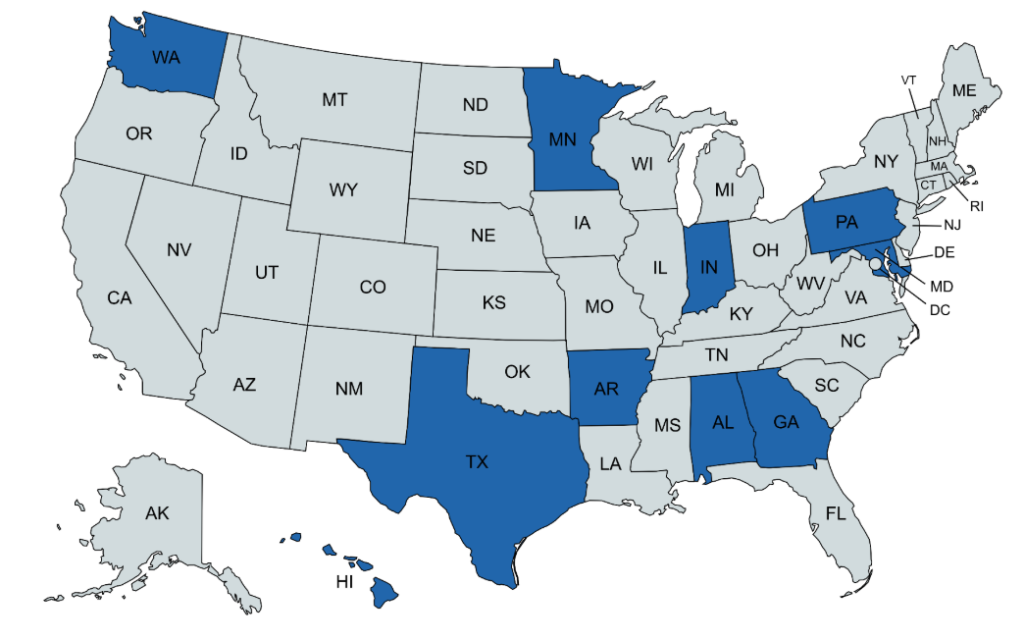
These states were chosen because they represent a variety of approaches to CS teacher certification as well as a variety of levels of development of CS instruction. We also interviewed experts (such as state CS supervisors) in each state to gain a more contextualized understanding of pathways to CS teaching
What We Found
We identified over 80 different pathways to CS certification in total across these states, with requirements ranging from the more common (e.g., passing a CS content exam) to the less common (e.g., a portfolio review). Note that we only coded explicit requirements and not implicit ones. For example, many pathways – such as earning a CS license based on licensure in another state – do not explicitly require a bachelor’s degree. Although we may assume that the overwhelming majority of teachers do in fact have a bachelor’s degree, there are pathways to teaching (usually in career and technical education) that require an associate’s degree or even no degree at all. 
We found that interviews with state CS leaders were essential to gaining knowledge that was not necessarily apparent from the state’s licensure website and other online documentation. In some (but not all) states, teachers can earn an initial certification in CS at one or more colleges and universities. All states offer a way for a teacher certified in CS in a different U.S. state to earn certification in a new state. Sometimes, alternative providers (such as non-profits) have authority to offer a pathway to CS certification, either as an initial certification or as an add-on to another certification.
Our findings from this phase suggest some important implications for CS education. First, we compared our findings to the extended CAPE codebook (explore the codebook) to see if any themes emerged from our study of pathways that might suggest themes that are not common in previous CS education research. For example, our work suggests that it might be helpful to have additional categories in the extended CAPE codebook that specifically address the experiences of pre-service teachers. Additionally, our work outlining pathways and their requirements may be useful to professional development and curriculum providers, CS education researchers, certification pathway providers, and state-level decision-makers.
For more details about the project, you can read the ASEE paper here and see the SIGCSE poster itself.
Future Work
Our future work on this project includes adding information about more states as well as gathering data about the number and characteristics of teachers who follow each pathway. We expect that this dataset will yield important insights into the landscape of CS teacher preparation in the US.
Acknowledgement & Reference
We acknowledge Google.org for their generous support of this project.
Smith, J. and Rosato, J. 2026. Pathways to Teaching K12 Computer Science: Implications of a Pilot Study of Ten States. In Proceedings of the 57th ACM Technical Symposium on Computer Science Education V.2 (SIGCSE TS 2026), Vol. 2. Association for Computing Machinery, New York, NY, USA, 1529–1530. https://doi.org/10.1145/3770761.3777200
Smith, J. and Rosato, J. (2026). Pathways to Licensure for Computer Science Teachers: The Data Landscape. Paper presented at the 2026 ASEE Annual Conference & Exposition, Charlotte, North Caroline. https://doi.org/10.18260/1-2–60403